Understanding Peptide Pureness: What 99%+ Truly Implies
Peptide Testing: Hplc & Mass Spec Pureness Overview Pinnacle

Complementing HPLC, laboratories make use of Mass Spectrometry (typically combined as LC-MS) to verify the peptide's molecular weight and series identity. Mass spectrometry provides molecular confirmation by detecting the exact mass of the peptide and any kind of co-eluting types or abbreviated series with high accuracy. Together, HPLC and MS data permit analysts to confirm that the peptide's composition matches what it should be (proper amino acid sequence and anticipated adjustments) which no significant contaminants exist.
In easy terms, a peptide listed as 95% pure consists primarily of the target peptide (95%), with the staying ~ 5% composed of pollutants. These pollutants can consist of points like reduced or abbreviated sequences, removal variations, oxidized deposits, or other small side-products from the synthesis process. Peptides are widely utilized in the clinical aesthetic appeals, cosmetics, and biomedical areas as a result of their one-of-a-kind organic task and wide application capacity. Nevertheless, the quality of peptide products directly influences their efficiency and safety, making precise top quality screening services essential.Comprehending Peptide Purity Screening
Each peptide has actually a various expected molecular weight, so mass verification is not a generic badge; it is compound-specific proof. For a much deeper identity-focused description, see Mass Spectrometry Peptide Verification. Identity testing validates that what was synthesized is in fact the desired series.- Certification by relevant bodies (such as ISO/IEC or qualification for GLP/GMP compliance) is a strong indication of top quality.
- BOC Sciences offers increased stability, light stability, and chemical deterioration experiments to systematically assess solution stability threats.
- If the major peak has a visible "shoulder"-- a bump on one side-- that typically shows a very closely related contamination (like a removal peptide) that the column couldn't totally deal with.
These are beneficial in the best setting, yet they ought to be taken method-specific evidence instead of an universal replacement for HPLC and MS. Yet peptide purity is probably the single most important quality metric for any kind of research peptide. It straight influences the integrity and reproducibility of experimental results. A peptide provided at 75% purity and one at 99% pureness aren't just different grades-- they can generate meaningfully various results in the exact same assay.
Either can be appropriate, but third-party screening is the gold criterion for research-grade materials. Recurring solvents, such as DMF, acetonitrile, or DMSO, are quantified making use of gas chromatography (GC) techniques. These solvents can influence peptide performance, so exact quantification is important to make sure purity and prevent contamination in experimental setups. Peptide stability is Find out more examined under numerous problems to ensure integrity throughout study and product growth.
Research Uses Peptide Chemical & Physical Evaluations
We employ GC-MS, ICP-MS, and various other approaches to detect contaminations, making certain product security and regulatory conformity. Peptide sequencing is crucial for identifying the exact amino acid series of peptides, consisting of alterations like phosphorylation or acetylation. Sequencing enables researchers to comprehend the biological role of the peptide and its interaction with other molecules, aiding in the style of practical peptides for diverse applications. The peptide sample is dissolved in a suitable solvent and filled right into an autosampler.
Peptide Pureness Analysis Service
Other spectroscopic strategies, such as Infrared (IR) or UV-Vis analysis, are occasionally utilized for rapid quality checks or architectural verification. This is why credible distributors give both HPLC and MS information on their Certificates of Evaluation. Peptides in microspheres and nanoparticles may entangle with matrices, Analytical Testing making it difficult to divide free and encapsulated forms. We utilize dialysis, ultrafiltration integrated with HPLC/UV approaches to scientifically review encapsulation efficiency and drug loading. These evaluations are valuable when clients need more than a mass range and chromatogram to judge whether a whole lot is genuinely fit for measurable job.
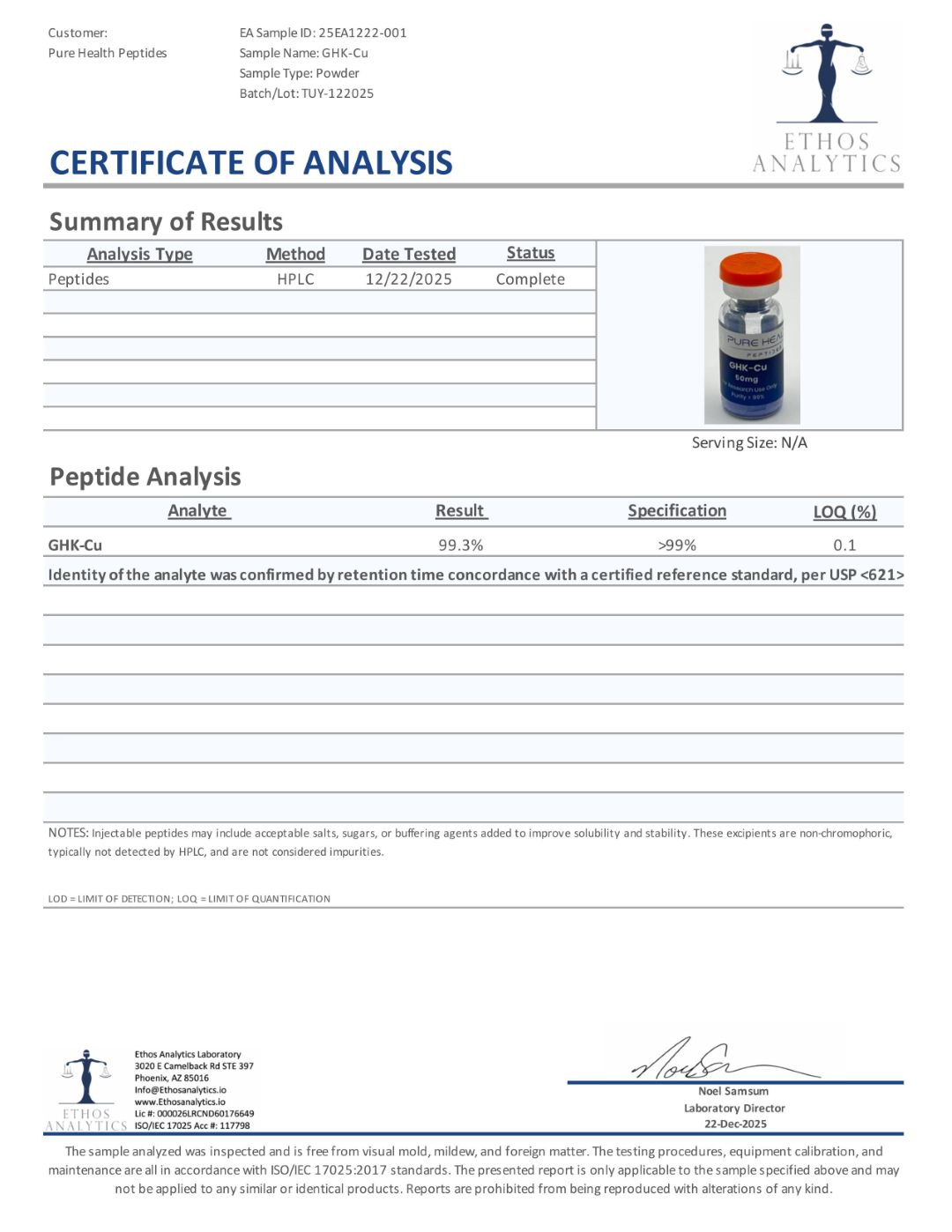
In addition to HPLC and MS, specialized labs may employ orthogonal methods for included accuracy. For example, capillary electrophoresis can be made use of to divide extremely hydrophilic peptides or to double-check results, and MALDI-TOF mass spectrometry can aid in mapping bigger or modified peptides. Lots of peptide producers or vendors will certainly supply a COA (Certificate of Analysis), as an example our bpc 157 tb 500 mix, that consists of the pureness percent by HPLC and identity confirmation by MS for each and every set. Top-tier laboratories frequently report peptide purity well over 95%, frequently ≥ 98-99%, by utilizing state-of-the-art HPLC and MS analyses. They also check both raw materials and completed peptide vials, which aids catch any type of impurities, destruction products, or formula variances.